
Having early information about new vulnerabilities that may put corporate cybersecurity environments at risk is essential to take the appropriate measures.
The Early Warning Service for Vulnerabilities provides information collected, compiled, and processed from multiple open information sources so that the time dedicated to understanding, at any given moment, the vulnerabilities and the risk they pose to our company is minimized. In addition, it allows tracking of these in a simple way to facilitate detection and the management of resolution, by the responsible teams, of new vulnerabilities in the simplest and most practical way.
Initial data
Before starting the monitoring of the specified products, information is requested about the defined scope, in order to configure the platforms and versions initially monitored, which will be updated when changes occur.
Monitoring process
Once the products (platforms and versions) are confirmed, the vulnerability monitoring process will begin for those products.
This process includes the following stages:
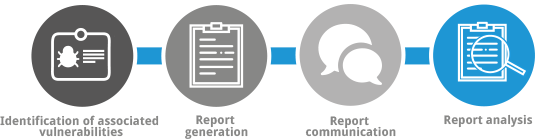
Identification of associated vulnerabilities
The Early Warning service monitors vulnerability publication databases and detects those that may affect the products specified in the scope. The associated CVE is identified, along with its publication date, CVSS score, and a description.
Report generation
Based on the information gathered in the previous stage, a report is generated detailing the results obtained.
Report communication
Depending on the specified frequency, a report will be provided that reflects the level of criticality of each vulnerability (based on the associated CVSS) to help prioritize the application of corrective measures.
Report analysis
Once the Early Warning report is received, organizations must analyze it to assess whether any of the reported vulnerabilities could be a false positive and label it as such.
As a result of the service, Internet Security Auditors will provide, via email, a report that will include, among other information, for each monitored product:
- CVE of each vulnerability associated with the product.
- Description of each vulnerability.
- CVSS associated with each vulnerability.
- Status of the vulnerability.